
A logo is one of the most important visual assets of any brand. You’ll notice it on websites, packaging, social media, advertisements, stationery, and signage. Knowing how to design a logo for a business goes beyond creating an appealing symbol. A good logo should capture the personality of the brand, resonate with the audience, and be easily recognizable across different platforms.
A good logo can create a great first impression and increase a business’s brand awareness. It ensures consistency with a clear visual identity for the company. A defined logo design process helps designers make better decisions on typography, colors, symbols, and overall visual direction.
It is important to understand the business itself before starting the design. Its audience, competitors, values, personality, and position in the market all play a part in the final identity. If you’re learning how to design a company logo, the first step is not to jump right into software or visual effects but to understand the brand.
What Makes a Good Business Logo?
A good logo should be simple, memorable, relevant, unique, and flexible. It needs to convey the right message but not look complicated or cluttered.
A logo with meaning behind it can better connect with the audience. You can derive meaning from the company’s values, story, product, purpose, or positioning. But the design should still be easy to figure out.
Strong logo design rules also consider practicality. The logo needs to be readable on a mobile screen, website header, business card, packaging, and even large signage.
How to Design a Logo for a Business Step by Step
In terms of how to design a logo for a business, it’s easier if you break the work down into clear stages. Every step takes the project from brand research to final execution.
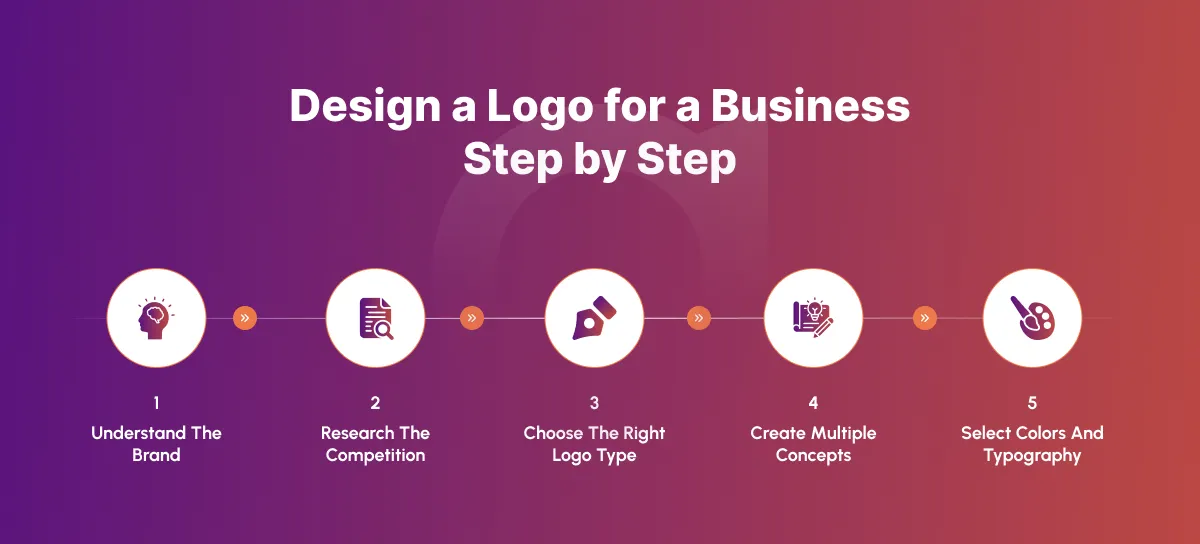
Step 1: Understand the Brand
First, identify the most important information you have about the company. Know its mission, values, products, services, audience, and voice.
Ask simple questions such as:
- What does the brand offer?
- Who is the target audience?
- What makes it different?
- What should customers feel?
- What should they remember?
The responses provide a good basis for the logo design process and help avoid arbitrary creative decisions on the part of the designer. For businesses looking for expert support, working with a professional Logo Design Company In Ahmedabad can help create a strategic and distinctive visual identity.
Step 2: Research the Competition
Study brands operating in the same category. Look at their logo styles, colors, typography, symbols, and overall visual language.
Competitor research is not aimed at imitation. However, through research you can find similarities and ways to create a more unique design.
It is essential when studying the basics of how to design a company logo as the logo should blend into the industry yet be unique.
Step 3: Choose the Right Logo Type
Various companies require various kinds of logos. This depends on the firm’s name, its characteristics, and how it will be used in the future.
Logo Type | Best For | Key Benefit |
Wordmark | Distinctive business names | Builds name recognition |
Lettermark | Long company names | Creates a compact identity |
Symbol Mark | Visual-first brands | Improves recognition |
Combination Mark | Growing businesses | Offers more flexibility |
Choosing the correct format makes it easier to use the logo across different brand touchpoints.
Step 4: Create Multiple Concepts
It is not recommended to accept the first option that comes to your mind. Create some ideas and experiment with their combinations.
Creating a logo with meaning behind it or notions can become memorable for the consumer. These ideas can originate from the company’s name, its story, product, target audience, or mission.
Try to create an idea, which will be easy to understand and comprehend.
Step 5: Select Colors and Typography
Colors and typography strongly influence brand perception. Bold fonts can communicate confidence, while softer typefaces may create a more friendly or approachable feel.
Useful tips on logo design include picking colors and fonts sparingly and ensuring that the fonts chosen are easily readable at all sizes.
Avoid fonts that are fashionable just to be fashionable. Fonts need to work well with the brand and last a long time.
Important Logo Design Rules
When learning how to design a logo for a business, these basic checks can help improve the final result:
- Keep it simple
- Make it memorable
- Stay brand relevant
- Ensure scalability
- Maintain originality
These logo design rules help create a logo that works effectively across both digital and physical applications.
Test the Logo Across Different Applications
Sometimes, the logo looks good on a large design screen but does not work when used in practice.
Test the logo on:
- Website headers
- Social media icons
- Product packaging
- Business cards
- Outdoor signage
One of the most practical tips on logo design is to test the logo in black and white. If the design remains recognizable without color, its basic structure is usually strong. Before finalizing your visual direction, exploring the latest Top Logo Design Trends can help you understand which styles are evolving and which approaches may have long-term value.
Common Logo Design Mistakes to Avoid
Too many concepts in a single design is a frequent mistake in logo creation. Sometimes people try to convey all the services, products, or values of the brand in a single design, which is unnecessary.
Frequent use of design trends is another common mistake. Even though trends give inspiration for design, a logo should never be dependent on them as they may become out-of-date very soon.
When learning how to design a company logo, a person should not copy competitors. There must be some originality in order to make customers recognize a company.
DIY Logo Design vs Professional Logo Design
DIY logos can serve for very simple identity purposes while professional designing offers an advanced solution.
- Better brand strategy
- More original concepts
- Stronger visual quality
- Better scalability
- Consistent brand use
Professional designers also consider positioning, typography, proportion, color psychology, and practical applications. A complete logo design process usually includes different logo versions for varied brand requirements. If you want to understand how memorable visual identities are built, this guide on Designing Brand Symbols explains how symbols can strengthen recognition and brand recall.
Why Logo Testing Matters
Testing plays an important role while designing how to design a logo for a business. The design should be readable and recognizable in small and large formats.
It should also look good against light and dark backgrounds, on websites, in print, on packages, on social media, and in signage. Testing can help you identify any problems with spacing, contrast, proportion, or legibility.
Following practical tips on logo design during this stage helps reduce future problems and supports a more consistent brand identity.
Conclusion
Learning how to design a logo for a business requires research, strategy, creativity, and careful testing. A successful logo should be simple, memorable, relevant, and flexible enough to work across different applications. A strong logo with meaning behind it can also support brand storytelling and improve recognition over time.
Frequently Asked Questions
Start by understanding the brand, target audience, competitors, positioning, and personality before creating visual concepts.
The most important principles are simplicity, originality, relevance, scalability, readability, and consistency.
Professional designers can provide a more strategic, original, and flexible identity that works across multiple brand applications.

Mahendra Bhatiya
With 15+ years of brand-building experience, Mahendra Bhatiya helps food and FMCG businesses transform good products into trusted, memorable, and market-ready brands. His focus is on building brands that inspire stronger customer confidence, create a better market presence, and deliver long-term business value.