
A good product can create customer satisfaction. But before a customer experiences the product, the brand must first earn attention, understanding and trust.
That is where brand identity design contributes to business growth.
Brand identity does not automatically increase sales, and it cannot repair a weak product, poor distribution or an unclear offer. What it can do is make a good business easier to recognise, understand, trust, choose and remember.
For food and FMCG brands, this matters at every point of purchase: on a supermarket shelf, inside a distributor catalogue, on a quick-commerce app, in a social media reel, on a product detail page and eventually inside the customer’s home.
The real value of identity is therefore not simply that it makes a brand look professional. It creates a consistent decision-making system around the product.
Brand identity design helps a business grow by translating its strategy into recognisable visual and verbal signals. For food and FMCG brands, those signals reduce confusion, build confidence, improve shelf and screen recognition, support perceived value and create consistency across packaging, communication and future product launches.
Why does brand identity matter more for Indian FMCG brands now?
India’s FMCG market is becoming increasingly channel-dependent. NIQ’s Q1 2026 assessment describes a shift from broad expansion toward more selective, channel-led growth, with modern trade and e-commerce playing a larger role. It also highlights the importance of adapting pack architecture to changing prices, channels and affordability conditions. (NIQ)
This means that a food brand is no longer designed only for a physical shelf.
The same product may need to work as:
- a two-centimetre marketplace thumbnail
- a quick-commerce search result
- a shelf-facing pack
- a distributor presentation
- a social media video
- a product held by a creator
- a family of multiple flavours and sizes
An identity that works in only one of these situations is incomplete.
At the same time, Indian food buyers are balancing price, taste, health, culture and trust. PwC’s 2025 India consumer research found that 63% of respondents were concerned about food costs, 74% said their food choices were rooted in cultural heritage and 84% were extremely or very concerned about food safety.
This creates a demanding communication task.
A pack may need to feel contemporary without losing cultural relevance. It may need to appear premium without looking unaffordable. It may need to highlight nutrition without making unsupported promises. It may need to look fresh on Instagram while remaining clear to a customer making a quick retail decision.
Brand identity helps organise these competing signals.
How does brand identity design support business growth?
1. It reduces decision friction
Customers rarely study every product in a category with equal attention.
They scan.
They look for answers such as:
- What is this?
- Is it meant for me?
- What makes it different?
- Can I trust it?
- Which flavour or variant is this?
- Is the price justified?
A clear identity answers these questions in the right order.
For example, a millet snack brand may have strong nutritional credentials, regional ingredients and an appealing founder story. But if the front of the pack gives equal importance to fifteen messages, none of them will be understood quickly.
Good identity design creates hierarchy. It decides what customers should notice first, second and third.
The business advantage is not merely better-looking packaging. It is faster comprehension.
2. It builds confidence before product trial
Food is a trust-sensitive category.
Before opening the pack, customers cannot fully verify taste, texture, freshness or production quality. They therefore depend on signals.
Those signals may include:
- clear ingredient communication
- disciplined typography
- accurate claims
- credible photography
- consistent labelling
- professional finishing
- visible product information
- a coherent relationship between price and presentation
Customers do not consciously analyse each signal. They experience their combined effect as confidence or doubt.
A disciplined identity cannot prove product quality by itself, but it can communicate that the business pays attention to detail.
3. It improves recognition and recall
Businesses often assume that recognition comes from showing the logo more prominently.
In reality, customers remember combinations:
- a colour relationship
- a pack structure
- a distinctive type style
- an illustration approach
- a recurring shape
- a photography style
- a particular message rhythm
Strong brands create multiple connected memory cues.
This is especially important for repeat-purchase categories. When customers return to a crowded shelf or app, recognition reduces the effort required to find the product again.
The objective is not simply to be noticed once. It is to become easier to identify each time.
4. It strengthens both shelf and screen visibility
Shelf visibility and digital visibility are related but different.
On a physical shelf, customers may see pack shape, size, colour blocks and neighbouring competitors.
On a mobile screen, the same pack may appear extremely small. Fine details disappear. Long claims become unreadable. Subtle colour differences collapse.
A growth-ready identity must survive both contexts.
This is why food brands should test packaging at several sizes:
- full-size artwork
- realistic shelf distance
- e-commerce product card
- quick-commerce thumbnail
- social-media feed
- black-and-white printout
- low-brightness mobile screen
A pack that looks impressive only in a presentation mock-up is not necessarily market-ready.
5. It supports perceived value
Price is a number. Value is an interpretation.
Identity affects that interpretation by helping customers understand:
- the quality level
- the intended usage occasion
- the product’s difference
- the level of care behind it
- whether it belongs in an economy, mainstream, premium or specialist segment
This does not mean that premium brands should always use minimal layouts, muted colours or gold foil.
Those are visual conventions, not strategy.
A premium spice brand may need richness, regional detail and sensory abundance. A children’s snack may need energy and accessibility. A traditional pickle may need authenticity without appearing outdated.
Perceived value improves when the design expression matches the product promise and intended market position.
6. It reduces creative and operational waste
Weak brand identity creates costs that are easy to overlook.
Teams repeatedly debate colours, layouts, photography styles and message formats. Different agencies interpret the brand differently. Retail presentations do not match social media. New products require the design process to restart almost from zero.
This is identity debt: the accumulated cost of inconsistent decisions.
A complete identity system gives teams reusable principles. It helps them create:
- new packaging variants
- retailer listings
- sales presentations
- festival communication
- social posts
- advertisements
- photography briefs
- product films
- display material
Consistency can therefore improve both customer recognition and internal efficiency.
7. It makes expansion easier
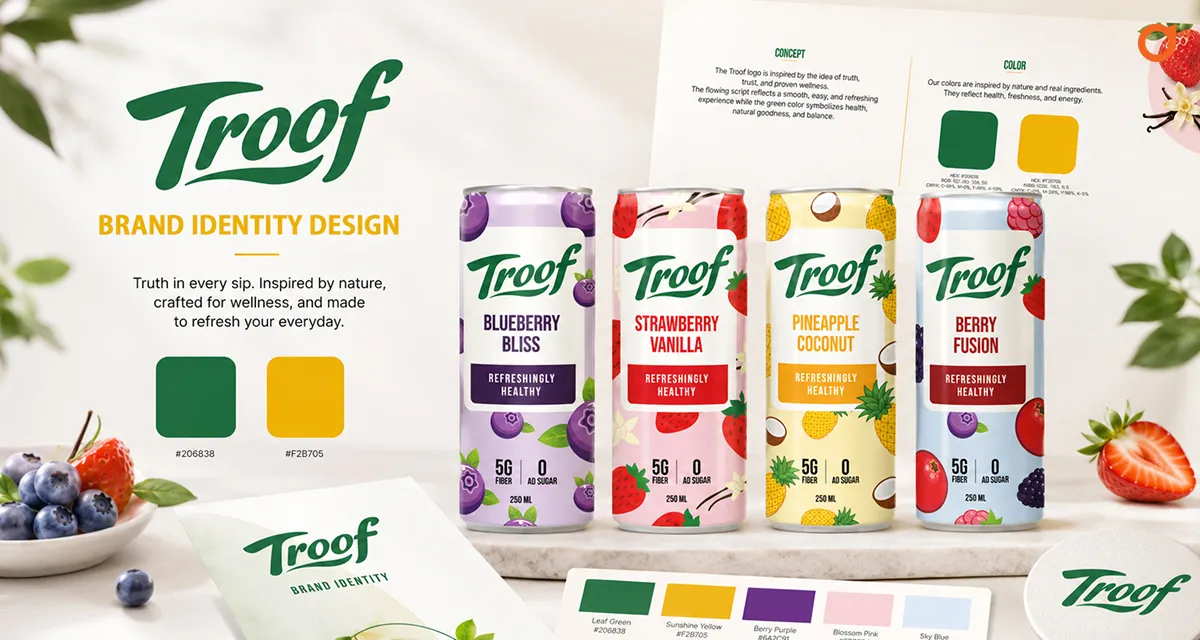
Many FMCG identities work for one product but fail when the company launches its fourth or fifth variant.
Common problems include:
- flavour colours that become confusing
- product names with no hierarchy
- inconsistent pack structures
- sub-brands competing with the master brand
- premium and mass products looking identical
- new categories that do not fit the original system
A scalable identity anticipates growth.
It defines which elements remain constant and which can change across:
- flavours
- categories
- sizes
- price points
- regions
- audiences
- sub-brands
That flexibility allows the business to expand without becoming visually fragmented.
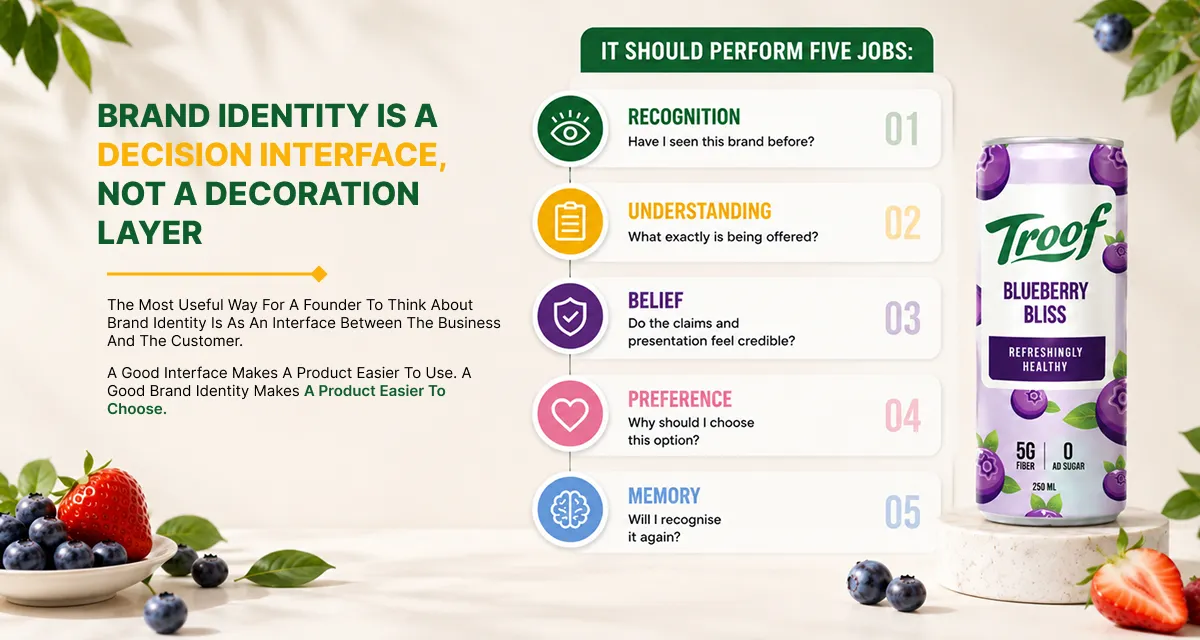
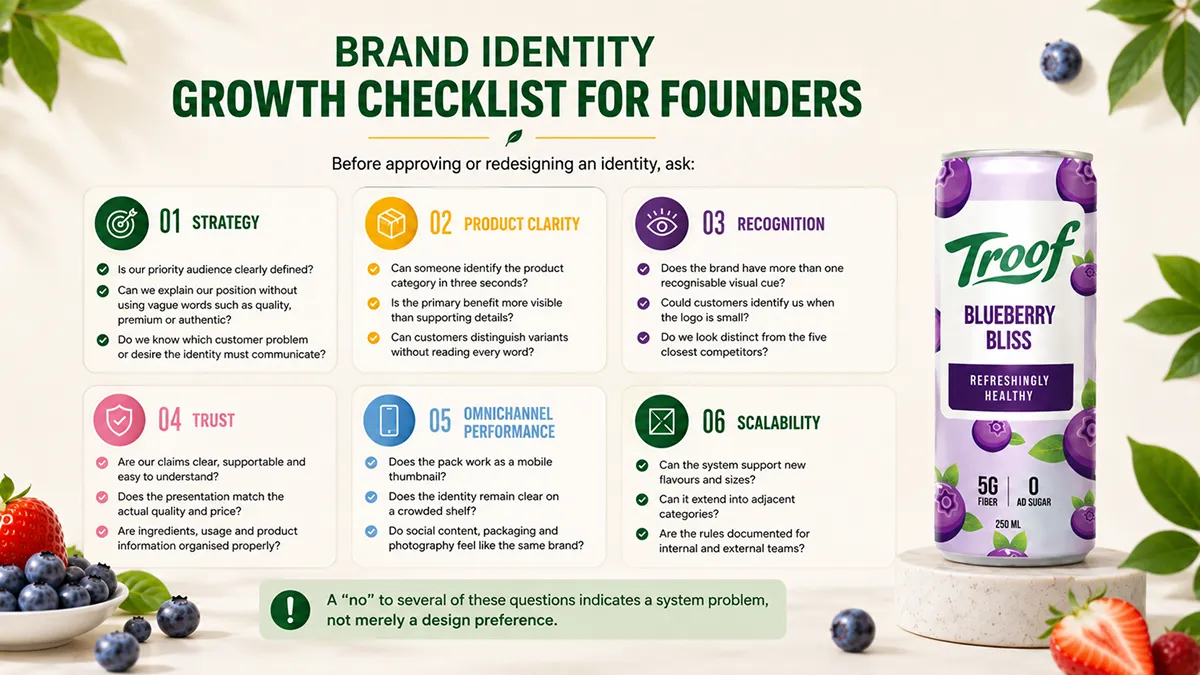
This perspective changes the design conversation.
Instead of asking, “Does this look modern?” the team begins asking:
- Can a customer identify the category immediately?
- Is the strongest reason to buy visible?
- Does the pack communicate the correct price position?
- Can customers distinguish variants quickly?
- Does the identity remain recognisable without the logo?
- Will it work in a thumbnail?
- Can the system support twenty future products?
These are business questions expressed through design.
The Brand Identity Growth Equation
A practical way to evaluate identity is through five connected factors:
Growth-ready identity = Clarity × Distinctiveness × Credibility × Consistency × Adaptability
The multiplication sign matters.
If one factor is extremely weak, strength in the others may not compensate.
Clarity
Can customers understand the product and its primary value quickly?
Clarity includes category communication, message hierarchy, variant naming and readable information.
Distinctiveness
Can customers recognise the brand without confusing it with competitors?
Distinctiveness comes from ownable combinations, not simply unusual logos.
Credibility
Does the identity support trust?
Credibility requires accurate claims, appropriate visual signals, clear information and alignment between product quality and presentation.
Consistency
Does the same brand feel connected across packaging, photography, social content, retail material and video?
Consistency builds familiarity. It should preserve recognisable principles without forcing every communication to look identical.
Adaptability
Can the identity work across new channels, formats, products and audiences?
A system that cannot adapt will either restrict growth or gradually lose consistency.
Common brand identity mistakes
Designing before positioning
This creates attractive options without a clear basis for choosing between them.
Copying the category leader
Looking familiar can help customers recognise the category, but excessive imitation makes the smaller brand appear replaceable.
Overloading the front of the pack
When every benefit is emphasised, the customer cannot determine which one matters most.
Treating photography as a separate activity
Photography shapes appetite, product quality and price perception. It should be part of the identity system, not an unrelated final-stage requirement.
Designing only for the shelf
An identity that depends on fine detail may disappear on quick-commerce and marketplace screens.
Creating one pack instead of a packaging system
The first design may look strong, but future flavours, sizes and categories become inconsistent.
Using unsupported visual or verbal claims
Trust can be damaged when natural, healthy, traditional or premium claims are expressed more strongly than the product can prove.
Rebranding without a transition plan
Retailers, distributors, digital listings and existing customers need help connecting the old brand with the new one.
Conclusion
Brand identity helps a business grow when it makes the business easier to recognise, understand, trust and choose.
For food and FMCG companies, its role extends far beyond the logo. It organises packaging, portfolio architecture, product communication, photography, digital listings, advertising and retail experience into one coherent system.
The strongest identities do not simply make products look different. They reduce decision friction, communicate proof, create memory and give the business a structure that can grow.
That is why brand identity should not begin with the question, “What style should we use?”
It should begin with:
What must customers understand, believe and remember for this business to grow?

Frequently
Asked Questions
Asked Questions
Brand identity does not guarantee sales. It improves the conditions that support sales by making a product easier to recognise, understand, trust and remember. Product quality, price, distribution, availability and promotion still affect the final result.
A logo is one visual identifier. Brand identity is the complete system surrounding it, including colours, typography, packaging, messaging, photography, tone of voice and usage rules.
Customers cannot fully judge taste, freshness or quality before purchase. They depend on packaging, information, claims, photography and visual consistency as signals of credibility and value.
Yes. Strategy defines the audience, positioning, promise and reasons to believe. Identity then translates those decisions into recognisable visual and verbal communication.
Consider rebranding when the identity no longer reflects product quality, the portfolio has become confusing, packaging performs poorly across channels, the brand is entering a new segment or customers regularly misunderstand the offer.
The timeline depends on research depth, portfolio size, packaging formats, stakeholder approvals and testing. A full strategy, identity and packaging system requires more time than a standalone logo.
A smaller brand does not need to outspend a market leader. It needs sharper positioning, more focused communication, credible proof, consistent execution and a distinctive identity that customers can recognise.
Review whether the agency explains its strategic reasoning, understands food and FMCG buying behaviour, designs systems rather than isolated assets, demonstrates packaging expertise and presents credible case studies rather than only attractive mock-ups.

Mahendra Bhatiya
With 15+ years of brand-building experience, Mahendra Bhatiya helps food and FMCG businesses transform good products into trusted, memorable, and market-ready brands. His focus is on building brands that inspire stronger customer confidence, create a better market presence, and deliver long-term business value.